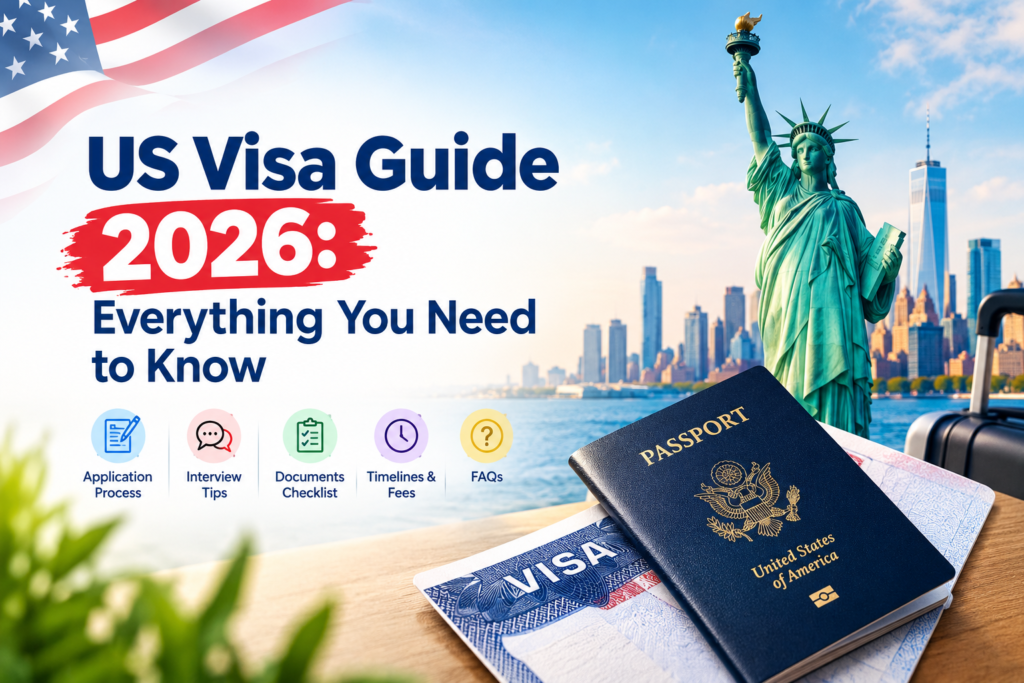
US Visa Guide 2026: Everything You Need to Know
The United States remains a popular destination for tourists, students, and business travellers, but obtaining a US visa can be challenging. Applicants must meet the relevant eligibility criteria, submit accurate documents, and prepare for the visa interview. US visa policies, including requirements for B-1/B-2 visitor visas and F-1 student visas, may change over time. Visa Lounge helps applicants understand visa requirements, documentation, and application procedures for a smoother application experience.
The US visa process involves careful document review and, in many cases, an interview with a consular officer. Your application outcome may depend on your eligibility, the accuracy of your DS-160 form, and how clearly you explain your travel purpose. At Visa Lounge, we help applicants prepare their documents and understand the visa interview process.
This US Visa Guide 2026 brings together essential information on US visa categories, Section 214(b) refusals, visa bond requirements, F-1 student visas, DS-160 form filling, and interview preparation. Explore the key eligibility criteria, documentation requirements, and common application mistakes to better understand the US visa process.
For detailed information about applying for a US visa, visit our US Visa Guide and explore the guidance available on Visa Lounge.
Latest US Visa Updates and Policy Changes for 2026
Here are some important US visa updates that applicants should know before starting their application process:
US Visa Bond Program: The visa bond pilot program has introduced additional requirements for certain applicants from designated countries. Eligible applicants may be required to provide a refundable bond of $5,000, $10,000, or $15,000.
Visa Bond Payment: Applicants must follow official instructions regarding Form I-352 and payment through the US Treasury’s Pay.gov portal. Payment should only be made when directed by a consular officer.
B-1/B-2 Visa Refusals: Visitor visa applications are assessed individually, and refusal rates vary by country and consulate.
F-1 Student Visas: Students must meet the relevant eligibility requirements, submit accurate documentation, and clearly explain their study plans.
DS-160 Form: Completing the DS-160 accurately and ensuring that all information matches your supporting documents is an important part of the application process.
Visa Interview Wait Times: Appointment availability varies by location, visa category, and season. Applicants should check the latest official wait-time estimates before planning their travel.
Interview Waivers: Eligibility for interview waivers depends on current US visa rules and individual circumstances. Applicants should verify the latest requirements before applying.
H-1B Visa Program: The H-1B program remains subject to annual numerical limits and applicable selection procedures, with certain exemptions.
Visa Application Fees: Fees depend on the visa category and applicable government rules. Check the official US visa fee schedule before making a payment.
Visa Bond Compliance: Applicants subject to bond requirements must follow the applicable conditions to avoid potential financial penalties or bond forfeiture.
The US Bond Rule Explained
The US Visa Bond Program was introduced on 20 August 2025 as a pilot initiative, with its coverage expanding to 50 countries on 2 April 2026. The program is scheduled to run until 5 August 2026, subject to official updates and applicable requirements.
What Is the US Visa Bond Rule?
Under the US Visa Bond Program, eligible applicants from designated countries may be required to provide a refundable bond of $5,000, $10,000, or $15,000 as a condition of visa issuance. The amount is determined by the consular officer.
The bond may be returned when the applicant meets the applicable program conditions, such as:
Departing the United States within the authorised period.
Not travelling to the US before the visa expires.
Being denied admission at a US port of entry.
Failure to comply with the bond conditions may result in forfeiture.
Countries Covered by the US Visa Bond Program
The program applies to nationals of designated countries, with the list subject to change under US government policy. The countries reportedly added on 2 April 2026 include Cambodia, Ethiopia, Georgia, Grenada, Lesotho, Mauritius, Mongolia, Mozambique, Nicaragua, Papua New Guinea, Seychelles, and Tunisia.
Applicants should consult the official US Department of State website for the latest country list and eligibility requirements before applying.
How to Pay the US Visa Bond
Applicants who are instructed to provide a visa bond should follow the official procedure:
The consular officer determines the applicable bond amount.
The applicant completes the required DHS Form I-352.
Payment is made through the official Pay.gov portal only after receiving instructions from the consular officer.
Applicants should avoid unauthorised payment requests and third-party websites.
US Entry and Exit Requirements for Visa Bond Holders
Applicants subject to the bond program must follow the designated entry and departure procedures specified by US authorities. The permitted ports of entry and exit may be restricted under the program.
Before booking flights, check the current official rules regarding commercial airports, land borders, seaports, and private or charter flights. Using an unauthorised port of departure could affect the return of the bond.
What Should Applicants Know Before Applying?
If your nationality is covered by the US Visa Bond Program, consider the following points:
Budget carefully: Be prepared for a potential bond requirement of $5,000 to $15,000, if applicable.
Check travel arrangements: Confirm the permitted entry and exit locations before finalising your itinerary.
Prepare your application: Ensure your DS-160 form, supporting documents, and travel plans are accurate and consistent.
Follow official instructions: Verify the latest bond rules and payment process with the US embassy or consulate.
Understanding Section 214(b): A Key Rule in US Visa Applications
Section 214(b) of the US Immigration and Nationality Act is an important rule that can affect applications for non-immigrant visas, including tourist and business visas. Under this provision, applicants must demonstrate that they qualify for the visa category they have applied for.
What Does Section 214(b) Mean?
For many non-immigrant visa categories, applicants are presumed to be intending immigrants unless they establish their eligibility for temporary entry. Consular officers assess each application individually, considering the applicant’s circumstances, travel plans, financial situation, and ties to their home country.
What Do Consular Officers Consider?
Two important factors in a US visitor visa application are:
Purpose of travel: Applicants should clearly explain their reason for visiting the United States, whether for tourism, business meetings, medical treatment, or another permitted purpose.
Ties to the home country: Employment, family responsibilities, financial circumstances, and other personal commitments may help demonstrate an intention to return after the visit.
Common Factors That May Lead to a Section 214(b) Refusal
Every application is assessed individually, but the following issues may raise questions about an applicant’s eligibility:
Limited evidence of ties to the home country: The applicant may not adequately demonstrate their personal, professional, or financial circumstances.
Recent employment changes: A short employment history may require further explanation.
Family connections in the United States: The purpose and duration of the visit should be clearly explained.
Limited international travel history: Previous travel can provide context, but it is not a mandatory requirement for every applicant.
Unclear travel plans: Applicants should explain their itinerary and intended activities.
Inconsistencies in the DS-160 form: Incorrect or conflicting information may raise concerns about the application.
Unclear interview responses: Applicants should answer questions honestly and consistently.
Previous immigration violations: Earlier overstays or other immigration issues may affect the assessment, depending on the circumstances.
These factors do not automatically result in a refusal. A decision depends on the complete application and the individual applicant’s circumstances.
Can You Appeal a Section 214(b) Refusal?
A refusal under Section 214(b) generally cannot be appealed through a formal appeal process. Applicants may submit a new application, pay the applicable fee, and attend another interview if required. However, reapplying does not guarantee approval.
Before applying again, it is helpful to review the reasons for concern, correct any errors, and provide clearer information about the purpose of travel and eligibility.
At Visa Lounge, we help applicants understand US visa documentation, review their application details, and prepare for visa interviews with greater confidence.
US Visa Categories Explained: Types, Purposes, and Eligibility
US Visa Types: Categories, Fees, and Eligibility
The United States offers different visa categories for tourists, students, professionals, and family members. Understanding the purpose, eligibility criteria, and applicable fees for each category can help applicants choose the right visa.
Major US Non-Immigrant Visa Categories
B-1/B-2 Visitor Visa: For tourism, business meetings, family visits, and eligible medical treatment. The permitted stay is determined by US border officials at the time of entry.
F-1 Student Visa: For international students enrolled in eligible academic programs at approved US educational institutions. Applicants must meet the relevant admission and financial requirements.
H-1B Specialty Occupation Visa: For eligible professionals seeking employment in qualifying specialty occupations with a US employer, subject to applicable sponsorship and petition requirements.
L-1A Intracompany Transfer Visa: For eligible executives and managers transferring from an overseas office to a related US company.
L-1B Intracompany Transfer Visa: For employees transferring to a related US office based on their specialised knowledge of the organisation’s products, services, or operations.
J-1 Exchange Visitor Visa: For eligible exchange programs involving students, researchers, professors, interns, trainees, and other approved participants.
O-1 Extraordinary Ability Visa: For individuals who can demonstrate extraordinary ability or achievement in qualifying professional fields.
C-1 Transit Visa: For eligible travellers passing through the United States while travelling to another destination.
Dependent Visas (F-2, H-4, L-2, and J-2): For eligible spouses and dependent children of individuals holding certain US non-immigrant visas. Eligibility and work or study permissions vary by category.
US Visa Fees and Processing
Visa application fees, petition charges, and additional requirements vary by visa category. Some applications may also require separate payments, such as the SEVIS fee for eligible student and exchange visitor applicants.
Visa validity, permitted length of stay, and entry conditions are not always the same. Applicants should check the latest official fee schedule and visa requirements before submitting an application.
What Affects US Visa Approval?
Visa decisions depend on the applicant’s eligibility, travel or study purpose, supporting documents, and individual circumstances. Refusal rates can vary by visa category, nationality, and consular location.
DS-160 Form: A Complete Guide to Your US Visa Application
The DS-160, also known as the Online Nonimmigrant Visa Application, is an essential part of the US visa application process. Applicants must provide accurate and complete information to help consular officers assess their eligibility.
What Information Does the DS-160 Form Require?
The DS-160 form generally asks for the following details:
Personal Information: Full name, date of birth, nationality, residential address, and marital status.
Travel History: Details of previous international trips, as requested in the form.
Visa History: Information about previous US visa applications, refusals, and past US visits.
Family Details: Information about parents, spouse, and certain family members living in the United States.
Employment History: Current employment, previous jobs, and relevant professional details.
Education Details: Educational qualifications and information about institutions attended.
Travel Plans: Purpose of the visit, intended travel dates, accommodation, and US contact details, where applicable.
Security and Background Information: Responses to questions relating to security, immigration, and other relevant matters.
Common DS-160 Form Mistakes to Avoid
Errors or inconsistencies in your application may lead to additional questions or delays. Common mistakes include:
Entering a name that does not match the passport.
Providing incorrect employment dates or personal details.
Omitting relevant information about family members in the United States.
Giving unclear or inconsistent travel information.
Answering questions about previous visa applications incorrectly.
Providing incomplete travel history where details are requested.
Entering incorrect or incomplete address information.
Tips for Completing the DS-160 Form
Take time to review every answer before submitting your DS-160 form. Check your passport, employment records, travel history, and other supporting documents to ensure that your information is accurate and consistent.
Important: Always review your completed application before submission. Providing accurate information is essential, and no visa consultant can guarantee approval.
The US visa interview is an important step in the application process for many applicants. During the interview, a consular officer may ask questions about your travel plans, financial circumstances, employment, and reasons for visiting the United States. The duration and questions vary depending on each applicant’s case.
Common US Visa Interview Questions
Applicants applying for a US visitor visa may be asked questions such as:
What is the purpose of your visit to the United States?
How long do you plan to stay?
Where will you stay during your visit?
Who will pay for your travel expenses?
What do you do for a living?
Have you travelled internationally before?
Do you have any family members living in the United States?
What is your current income or salary?
Have you ever been refused a US visa or a visa from another country?
Tips for a Successful US Visa Interview
Preparing in advance can help you communicate your travel plans clearly and confidently.
Be honest: Ensure your answers are accurate and consistent with your DS-160 form.
Explain your travel purpose clearly: State the main reason for your visit and provide relevant details.
Keep answers concise: Respond directly to the questions without unnecessary explanations.
Avoid memorised responses: Understand your application details and answer naturally.
Carry supporting documents: Keep relevant financial, employment, travel, and accommodation documents available in case they are requested.
Stay calm and confident: Listen carefully, answer truthfully, and ask for clarification if you do not understand a question.
What Happens After the US Visa Interview?
The consular officer will inform you of the next steps or the decision, where applicable. If your visa is approved, your passport may be retained for visa processing and returned according to the designated delivery procedure. Approval does not always mean immediate passport return.
If your application is refused under Section 214(b), you may generally submit a new application, subject to the applicable requirements and fees. However, reapplying does not guarantee approval.
At Visa Lounge, we help applicants understand the US visa application process and prepare for each important step.
DS-160 Form Guidance: Understand the information required and review your application for accuracy and consistency.
Visa Interview Preparation: Learn about common US visa interview questions and how to explain your travel purpose clearly.
Document Preparation: Get guidance on organising relevant financial, employment, travel, and supporting documents.
Previous Refusal Guidance: Understand how to disclose previous visa refusals accurately and address relevant concerns in a new application.
US Visa Bond Information: Learn about applicable visa bond requirements, eligibility conditions, and official payment procedures.
Appointment Guidance: Understand the visa appointment booking process and how to check available dates through official channels.
Application Process Updates: Learn about the key stages of your application, including passport return procedures.
Personalised Application Support: Get assistance in understanding the requirements relevant to your visa category and individual circumstances.
Explore Visa Lounge for US visa guidance, documentation support, and interview preparation.
Visa decisions are made by US consular officers. Visa Lounge cannot guarantee visa approval, appointment availability, or processing times.
Frequently Asked Questions
The US Visa Bond Program was expanded on 2 April 2026 to include 50 countries. The 12 countries reportedly added were Cambodia, Ethiopia, Georgia, Grenada, Lesotho, Mauritius, Mongolia, Mozambique, Nicaragua, Papua New Guinea, Seychelles, and Tunisia. Other countries previously included in the program include Nigeria, Bangladesh, Cuba, Venezuela, and Nepal. Applicants should check the latest official US Department of State guidance to confirm whether their nationality is covered by the bond requirement.
Applicants covered by the US Visa Bond Program may be required to provide a refundable bond of $5,000, $10,000, or $15,000 as a condition of visa issuance. The consular officer determines the amount during the interview. Applicants must complete DHS Form I-352 and make payment through the official Pay.gov portal only when instructed by a consular officer. The bond may be refunded if the applicant departs the United States within the authorised period, does not travel before the visa expires, or is denied admission at a US port of entry.
which may restrict exits to approved commercial airports, including certain CBP preclearance locations. Land borders with Canada or Mexico, seaports, and private or charter flights may not qualify as permitted departure points. Using a non-designated exit location could result in the forfeiture of the bond
The US visa application fee is generally $185 for B-1/B-2 visitor visas and is non-refundable. The MRV fee receipt is typically valid for one year, subject to applicable rules. Check the official guidelines before rescheduling your appointment.
No, the B1/B2 is strictly for business meetings and tourism. Any productive employment requires a work visa.
Up to 6 months per entry, at the discretion of the CBP officer at port of entry. The visa itself is typically valid for 10 years multiple-entry.
Yes, but parents visiting children in the US is one of the harder 214(b) profiles to satisfy. The US-resident child is itself a perceived return-risk factor. Strong ties at home must clearly outweigh the US connection.
Yes, every visa application form for almost every country asks whether you’ve been refused a visa anywhere. You must disclose. Failing to disclose can trigger multi-year bans for misrepresentation under most countries’ rules.