
Canada Visitor Visa for Indians 2026: Eligibility, Documents, Funds and Application Process
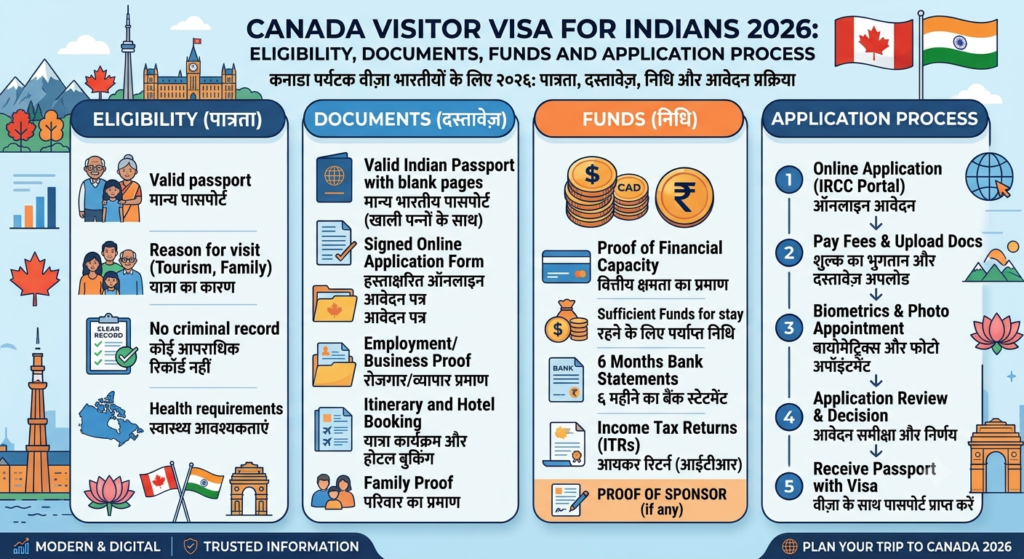
Canada is a popular destination for Indian travellers looking to explore its beautiful cities, natural landscapes, cultural attractions and family-friendly destinations. Whether you are planning to visit Toronto, Vancouver, Montreal or meet relatives living in Canada, obtaining a Canada Visitor Visa for Indians is an essential part of your travel preparation.
Indian passport holders generally require a Temporary Resident Visa (TRV), commonly known as a Canada Visitor Visa, to enter Canada for tourism or family visits.
The application process involves meeting the eligibility requirements, submitting financial and supporting documents, completing an online application and providing biometrics when required.
This guide covers everything Indian travellers need to know about the Canada tourist visa in 2026, including eligibility criteria, required documents, bank balance requirements, visa fees, processing time and the step-by-step application process.
1. What Is a Canada Visitor Visa?
A Canada Visitor Visa, officially known as a Temporary Resident Visa (TRV), is a travel document issued by Immigration, Refugees and Citizenship Canada (IRCC).
It allows eligible foreign nationals to travel to a Canadian port of entry and request permission to enter Canada for a temporary stay.
Indian citizens generally need a visitor visa for purposes such as:
Tourism and sightseeing.
Visiting friends and family members.
Attending family functions and social events.
Taking part in certain short-term recreational activities.
Attending eligible business meetings and conferences.
A visitor visa is generally issued as either a single-entry or multiple-entry visa. The validity period is decided by the immigration officer and may extend up to 10 years, or until the expiry of the passport or biometrics, whichever comes first.
Most visitors are allowed to stay in Canada for up to six months per visit, although the border services officer may determine a different period.
A visitor visa does not permit applicants to take regular employment or study in Canada without the appropriate authorisation.
2. Canada Visitor Visa Eligibility for Indians in 2026
Before applying for a Canada tourist visa, Indian applicants must satisfy the eligibility requirements established by IRCC.
The main eligibility criteria include:
Valid Passport: Applicants must hold a valid Indian passport or another accepted travel document.
Genuine Travel Purpose: You must clearly explain the reason for visiting Canada and your planned activities.
Financial Stability: You must demonstrate that you have sufficient funds to cover your travel, accommodation and daily expenses.
Strong Ties to India: Evidence of employment, family responsibilities, property or other commitments can help establish your intention to return.
Temporary Stay: You must convince the immigration officer that you will leave Canada at the end of your authorised stay.
Admissibility: Applicants must meet Canada’s health, security and immigration admissibility requirements.
Depending on your circumstances, IRCC may also request a medical examination, police certificate or invitation letter.
Meeting the eligibility criteria does not guarantee visa approval. Every application is assessed individually.
3. Documents Required for Canada Visitor Visa from India
Preparing the correct supporting documents is one of the most important parts of a Canada visitor visa application.
The exact document checklist depends on your personal circumstances and the purpose of your visit.
Commonly recommended documents include:
| Document | Purpose |
|---|---|
| Valid Indian Passport | Proof of identity and nationality |
| Previous Passports | Evidence of previous international travel |
| Passport-Size Photograph | Identification, if requested |
| Bank Statements | Evidence of financial stability |
| Income Tax Returns | Supporting evidence of income |
| Salary Slips | Proof of regular employment income |
| Employment Letter | Confirmation of current employment |
| Business Documents | Proof of self-employment or business ownership |
| Travel Itinerary | Details of intended travel plans |
| Accommodation Details | Hotel reservation or host information |
| Invitation Letter | If visiting friends or family in Canada |
| Proof of Relationship | Evidence of relationship with the person inviting you |
| Cover Letter | Explanation of travel purpose and financial arrangements |
Additional Documents Based on Employment Status
For salaried applicants:
Recent salary slips.
Employment verification letter.
Approved leave letter, if available.
Recent bank statements.
Income tax returns, where relevant.
For self-employed applicants:
Business registration documents.
Business bank statements.
Income tax returns.
Business ownership or operational evidence.
For students:
Student ID card.
Enrolment confirmation.
Leave approval from the educational institution, if applicable.
Sponsorship letter and sponsor’s financial documents, if someone else is funding the trip.
For retired applicants:
Pension statements, if applicable.
Retirement documents.
Bank statements.
Proof of other sources of income or financial support.
Applicants should ensure that all documents are genuine, consistent and relevant to their individual circumstances.
One of the most common questions among Indian applicants is: How much bank balance is required for a Canada tourist visa?
There is no fixed minimum bank balance officially prescribed by IRCC for every visitor visa applicant.
The amount of money you need depends on several factors, including:
Duration of your planned stay.
Number of people travelling.
Accommodation arrangements.
Flight and transportation expenses.
Daily living and food expenses.
Whether you are travelling independently or receiving financial support from someone in Canada.
For example, an applicant planning a two-week hotel-based holiday may need more funds than someone staying with relatives who are providing accommodation.
Documents That Can Support Your Financial Position
To demonstrate sufficient financial resources, applicants may provide:
Recent bank statements, preferably covering at least six months.
Salary slips or income proof.
Income Tax Returns (ITR).
Fixed deposit statements, where relevant.
Business income documents, if self-employed.
Sponsorship letter and sponsor’s financial evidence, if applicable.
Bank statements should show a clear and understandable financial history. Large or unexplained deposits immediately before applying may raise questions about the source of funds.
Can Someone Else Sponsor Your Canada Trip?
Yes. Another person, such as a family member or relative, can financially support your visit.
In such cases, you may include:
A sponsorship letter explaining the financial support.
Sponsor’s bank statements.
Sponsor’s employment or income documents.
Proof of relationship, where applicable.
Details of the expenses the sponsor will cover.
However, sponsorship does not automatically guarantee visa approval. The applicant must still satisfy the overall visitor visa requirements.
Indian applicants can generally apply for a Canada visitor visa online through the official IRCC application portal.
Follow these steps to complete your application:
Step 1: Check Your Eligibility
Review the official Canada visitor visa requirements and confirm that your purpose of travel falls under the permitted visitor activities.
Step 2: Create an IRCC Account
Visit the official Immigration, Refugees and Citizenship Canada website and access the appropriate online application portal.
Step 3: Complete the Application Form
Provide accurate personal information, passport details, travel history, employment information and details about your intended visit.
Step 4: Upload Supporting Documents
Prepare and upload the documents requested in your personalised document checklist. Make sure all uploaded files are clear and readable.
Step 5: Pay the Visa Application Fee
Pay the applicable visitor visa processing fee and biometrics fee, if required.
Step 6: Receive the Biometrics Instruction Letter
After submitting your application, IRCC will send a Biometrics Instruction Letter if you need to provide fingerprints and a photograph.
Step 7: Attend Your Biometrics Appointment
Book an appointment at an authorised Canada Visa Application Centre (VAC) in India and complete the biometrics process.
Step 8: Wait for the Visa Decision
IRCC will assess your application and may request additional documents or information if necessary.
If your application is approved, you may receive a passport submission request. Follow the instructions provided by IRCC for visa stamping and passport return.
6. Canada Visitor Visa Fees for Indians in 2026
The Canada visitor visa fees are charged in Canadian dollars (CAD). Applicants should check the official IRCC fee schedule before submitting their application.
The standard fees are:
Fee Type Amount (CAD) Visitor Visa Application Fee CAD 100 Biometrics Fee (Individual) CAD 85 Total for an applicant requiring biometrics CAD 185 For families applying together, IRCC offers a maximum visitor visa processing fee of CAD 500 for eligible families of five or more people. The family biometrics fee is capped at CAD 170 for eligible family members applying together.
Additional charges may apply for optional services offered by the Visa Application Centre.
Visa fees are generally non-refundable if the application is refused.
The final amount in Indian Rupees may vary depending on the applicable exchange rate and payment arrangements.
7. Canada Visitor Visa Processing Time in 2026
The processing time for a Canada visitor visa from India can vary depending on application volume, verification requirements and the individual circumstances of the applicant.
Factors that may affect processing time include:
Completeness of the application.
Time taken to provide biometrics.
Verification of financial and supporting documents.
Additional background or security checks.
Requests for further information from IRCC.
There is no guaranteed processing period for every application.
Indian applicants should check the latest processing time using the official IRCC processing time tool before making travel arrangements.
It is advisable to apply well in advance and avoid booking non-refundable flights or accommodation before receiving a decision.
8. Common Reasons for Canada Visitor Visa Rejection
A Canada visitor visa application may be refused if the immigration officer is not satisfied that the applicant meets the temporary resident requirements.
Some common reasons include:
Insufficient Financial Evidence: The applicant cannot demonstrate adequate funds for the planned visit.
Weak Ties to India: The application does not sufficiently establish reasons to return to India.
Unclear Travel Purpose: The itinerary or reason for visiting Canada is not convincing.
Inconsistent Information: Details in the application form do not match the supporting documents.
Unexplained Bank Transactions: Large deposits or unusual financial activity are not adequately explained.
Incomplete Documentation: Important supporting documents are missing.
Previous Immigration Issues: Relevant visa refusals, overstays or immigration violations are not properly addressed.
To reduce the possibility of refusal, applicants should provide accurate information, explain their financial circumstances and submit documents that support their stated travel purpose.
9. Tips to Strengthen Your Canada Visitor Visa Application
A well-organised application can help immigration officers understand your travel plans and personal circumstances.
Consider these practical tips before submitting your application:
Maintain a consistent financial record and explain unusual transactions.
Provide a realistic travel itinerary that matches your budget.
Clearly explain who will pay for your trip.
Include relevant employment or business documents.
Provide evidence of family, professional or financial commitments in India.
Disclose previous visa refusals wherever required.
Ensure that your application details match your supporting documents.
Avoid submitting fabricated reservations or financial documents.
There is no guaranteed way to secure a Canada visitor visa. A strong application should accurately represent your circumstances and demonstrate that your visit is temporary.
Plan Your Canada Trip with Visa Lounge
Planning a trip to Canada requires careful preparation, from understanding visitor visa requirements to arranging the right supporting documents.
At Visa Lounge, we assist travellers with visa application guidance, document preparation and travel-related support to help make the application process more organised.
Whether you are planning a holiday, visiting family or exploring Canada for the first time, getting the right guidance can help you prepare a clear and well-supported visa application.
Planning to visit Canada in 2026? Contact Visa Lounge for assistance with your Canada Visitor Visa application.