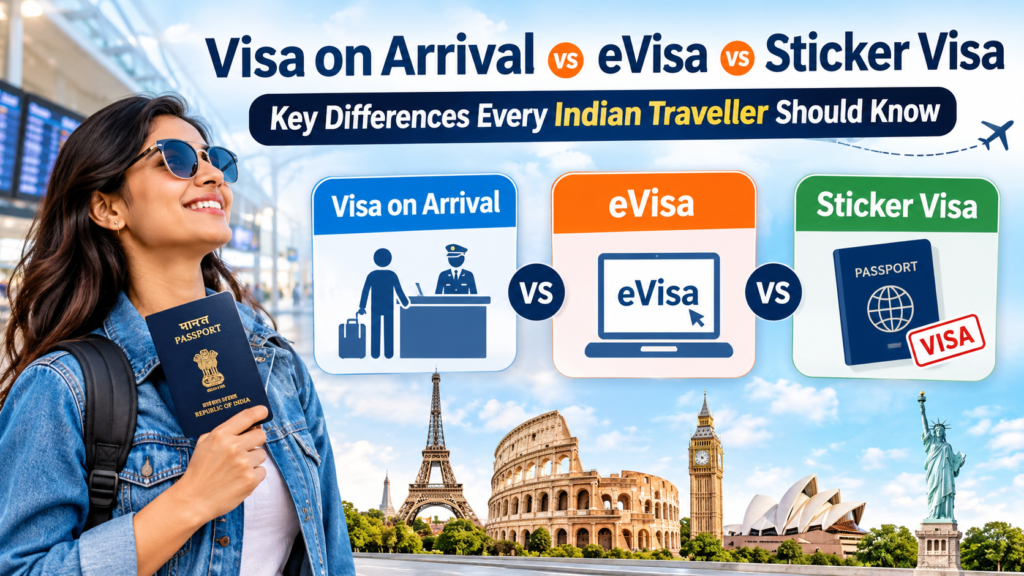
Visa on Arrival vs eVisa vs Sticker Visa: Key Differences Every Indian Traveller Should Know
Planning an international trip involves more than choosing your destination and booking flights. One of the first things Indian travellers need to understand is the type of visa required for their journey. Depending on the destination, travellers may be eligible for a Visa on Arrival, an eVisa or a traditional sticker visa.
Although all three options allow international travel when approved, their application procedures, processing times and entry requirements are different.
Understanding the difference between Visa on Arrival vs eVisa vs Sticker Visa can help Indian passport holders choose the correct application process, avoid last-minute complications and prepare for a smoother international journey.
What Is a Visa on Arrival?
A Visa on Arrival (VoA) is a travel authorisation issued to eligible travellers when they reach a designated airport or border entry point in another country.
Unlike traditional visas, travellers generally do not need to obtain the visa before departure. Instead, they complete the required formalities at the immigration counter upon arrival.
However, Visa on Arrival is not available to every nationality or for every destination. Some countries also require travellers to complete online pre-registration or obtain prior authorisation before boarding their flight.
Key Features of Visa on Arrival
No traditional embassy appointment is generally required.
The visa is issued at an eligible immigration checkpoint.
Applicants may need to provide accommodation details, return tickets and proof of sufficient funds.
Visa fees may be payable at the airport or border.
Approval remains subject to immigration authorities.
Popular Destinations Offering Visa on Arrival to Eligible Indian Travellers
Depending on the latest nationality specific rules and eligibility conditions, destinations may include:
Visa policies can change, and some destinations impose additional eligibility conditions. Always verify the latest entry requirements before travelling.
What Is an eVisa?
An electronic visa, commonly known as an eVisa, is a visa that travellers apply for online through an authorised government portal.
Instead of submitting a traditional paper application at an embassy or visa application centre, applicants upload their documents, complete the application form and pay the applicable fee electronically.
Once approved, the visa or Electronic Travel Authorisation (ETA) is generally sent digitally.
Travellers may need to carry a printed or electronic copy of their approval while travelling.
Key Features of eVisa
The application process is completed online.
Applicants can upload supporting documents digitally.
Visa fees are generally paid online.
Processing time depends on the destination and visa category.
Travellers may need to enter through designated airports or border checkpoints.
Approval must be obtained before travel unless the destination explicitly provides otherwise.
Popular Destinations Offering eVisa Facilities to Indian Citizens
Indian passport holders can explore online visa options for destinations such as:
For example, Indian travellers planning a holiday in Southeast Asia can explore the requirements in our Japan Tourist Visa Guide and other country specific visa guides before finalising their travel plans.
What Is a Sticker Visa?
A sticker visa, also known as a traditional or regular visa, is a visa issued by the embassy or consulate of the destination country and placed inside the traveller’s passport.
Unlike an eVisa, the traditional application process generally involves submitting physical or digital documents through an authorised visa application centre or embassy.
Applicants may also be required to attend an appointment for document verification and biometric collection.
Key Features of a Sticker Visa
-
Applications are submitted through an embassy, consulate or authorised visa centre.
-
Applicants may need to provide original documents and passport details.
-
Biometric information may be collected.
-
Processing time varies depending on the destination and visa category.
-
The approved visa is generally placed as a physical sticker or label in the passport.
-
Additional documentation or an interview may be required in certain cases.
Popular Destinations Where Indian Travellers May Need a Sticker Visa
Depending on the destination and applicable visa arrangements, examples include:
-
Germany
Travellers planning a European holiday can explore our detailed guides on France Tourist Visa for Indians, Spain Tourist Visa for Indians and Switzerland Visa Requirements for Indians.
Although all three visa types serve the purpose of authorising international travel, their application procedures and requirements differ significantly.
| Comparison | Visa on Arrival | eVisa | Sticker Visa |
|---|---|---|---|
| Application | At eligible arrival point | Online | Embassy or authorised visa centre |
| Advance approval | Depends on destination | Usually required | Required |
| Passport submission | Generally not required in advance | Usually not required | May be required |
| Processing | At immigration | Before departure | Before departure |
| Biometrics | Depends on destination | Depends on destination | May be required |
| Visa format | Physical or electronic record, depending on country | Digital approval | Passport sticker |
| Appointment | Generally not required | Generally not required | May be required |
The most suitable visa type depends on your destination, nationality, travel purpose and eligibility.
There is no single visa type that is best for every international traveller. Each option offers different advantages depending on the destination and travel requirements.
When Should You Choose Visa on Arrival?
Visa on Arrival can be convenient when your destination officially offers this facility to Indian passport holders.
It may be suitable for travellers planning short holidays who meet the country’s entry conditions and have all required supporting documents.
However, travellers should not assume that having a Visa on Arrival facility guarantees entry. Immigration authorities retain the right to assess eligibility.
When Should You Choose an eVisa?
An eVisa is a convenient option for travellers who prefer completing their visa application before departure.
It reduces the need for physical visits to embassies in destinations where a fully online application system is available.
It is particularly useful for travellers who want to receive their visa approval in advance and organise their travel documents digitally.
When Is a Sticker Visa Necessary?
A traditional sticker visa is necessary when the destination requires applicants to obtain a regular visa through an embassy or authorised visa application centre.
This is common for destinations with more detailed application procedures, biometric requirements or additional verification.
Travellers planning trips to the United States or Schengen countries should carefully review the relevant application process.
Documents Required for Different Types of Visas
Visa documentation varies by destination and visa category. However, travellers may commonly need the following documents.
For Visa on Arrival:
Valid passport.
Confirmed or onward travel arrangements.
Accommodation details.
Proof of sufficient funds.
Completed arrival or visa application form, if applicable.
Applicable visa fee.
For eVisa:
Valid passport.
Recent passport-size photograph.
Scanned passport information page.
Travel itinerary.
Accommodation details, where required.
Additional supporting documents depending on the visa category.
For Sticker Visa:
Valid passport.
Completed visa application form.
Recent photographs.
Bank statements and financial proof.
Travel itinerary.
Accommodation reservations.
Travel insurance, where required.
Employment or business documents, where applicable.
Always refer to the official immigration or embassy checklist for the exact requirements.
Common Mistakes to Avoid When Applying for a Visa
Choosing the wrong visa category or misunderstanding the entry requirements can create unnecessary travel complications.
Here are some mistakes Indian travellers should avoid:
Assuming Visa on Arrival Is Available to Everyone: Visa facilities depend on nationality, passport type and other eligibility conditions.
Using Unauthorised Websites: Always apply through official government portals or authorised visa application centres.
Travelling Without Visa Approval: An eVisa application receipt is not necessarily proof of approval.
Ignoring Entry Restrictions: Some electronic visas are valid only at designated entry points.
Providing Incorrect Information: Inconsistent personal details or misleading documentation can affect the application outcome.
Ignoring Visa Validity: Check the permitted duration of stay, number of entries and validity dates before travelling.
Get Help With Your International Visa Application
Understanding visa categories is an important part of planning an international trip. Whether you need an eVisa, Visa on Arrival guidance or assistance with a traditional visa application, preparing the correct documents can make the process more organised.
At My Travel Company, we help travellers understand destination specific visa requirements and navigate the application process.
From tourist visas to international travel documentation, our team can guide you through the requirements for your upcoming journey.
Planning your next international holiday? Explore our Visa Services or contact My Travel Company for assistance with your visa application.